
AUTOMATED MOBILITY SUMMIT KEY MESSAGES
- Europe has a fragmented regulatory framework for autonomous mobility. Level 3 autonomy is legally approved on motorways, but authorisation procedures, liability regimes and digital infrastructure investment diverge significantly across member states. China and the United States have moved faster through dedicated test corridors and accelerated certification.
- Scale is a prerequisite for commercial viability. The current fleet sizes in European deployments, typically five to fifteen vehicles, are not considered sufficient to attract series production from OEMs. Several speakers pointed to the need for deployments in the order of 100,000 vehicles before genuine product development becomes viable.
- No single business model has proven consistently viable in Europe. Profitability depends on multiple interdependent variables. B2G (government-contracted mobility) was identified by some speakers as a potential near-term avenue, alongside freight and port operations.
- Public trust is built primarily through direct experience. Data from Oslo (Ruter) shows high satisfaction rates after a first ride with a safety operator on board. Speakers raised questions around perceived safety in relation to gender, age and context, and around the transition to fully driverless operations.
- The challenge is no longer primarily technological but financial and institutional. The risk of value leakage (IP, jobs, data) outside Europe was raised, given that most operators active on the continent are not headquartered there. Calls were made to tie public funding to value retention criteria.
- Several speakers called for a move away from pilot projects towards permanent, self-funded deployments. Of the 80 pilot projects mapped across Europe, only 40 remain active.
5 KEY THEMES OF THE DAY
- Europe’s regulatory and deployment challenge
- Lessons from global operators: Waymo, Baidu / Apollo Go, Einride, Bolt
- Public trust, perceived safety and inclusion
- Viable business models in Europe
- Financing, venture capital and value retention

1. EUROPE AT A CROSSROADS
A fragmented regulatory framework, but one in motion
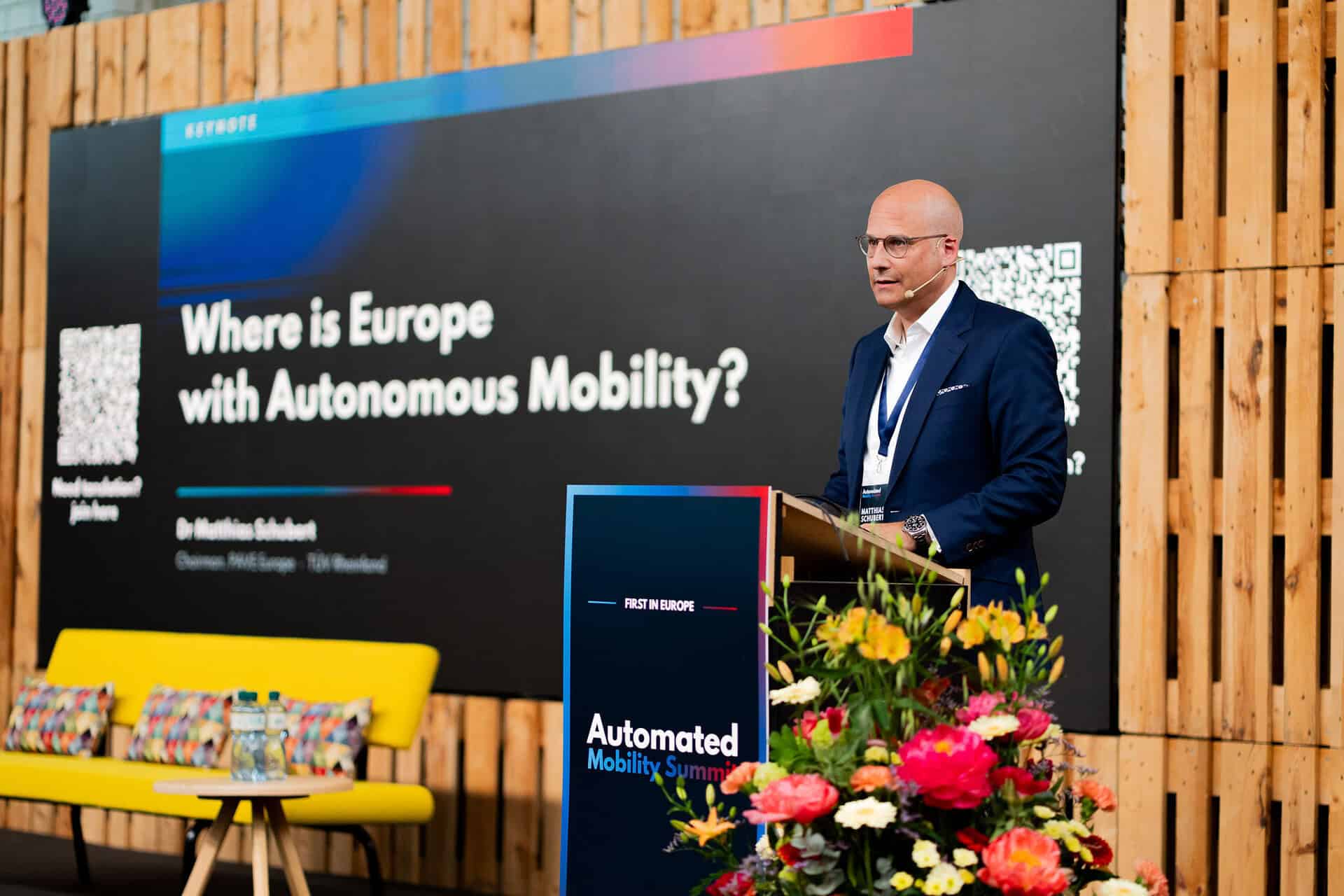
Dr. Matthias Schubert (TUV Rheinland, PAVE Europe Chairman) opened with a keynote on Europe’s regulatory position. He noted that Europe has Level 3 autonomy legally approved and commercially available on motorways, but that the map of national authorisations varies significantly across member states. Some member states are moving quickly; others remain on questions of liability and type approval. The UNECE WP.29 regulation provides a common framework, but its application diverges across the continent.
We couldn’t have selected a better venue than this one. Looking outside, you can physically see innovation growing. — Dr. Matthias Schubert, TUV Rheinland / PAVE Europe Chairman
He identified three structural bottlenecks: a lack of harmonisation between member states on testing and deployment authorisation procedures; the absence of a clear civil liability regime for driverless vehicles; and a lag in public investment in digital infrastructure — V2X connectivity and high-definition road mapping. On that last point, he noted that state investment in test corridors and accelerated certification in both China and the United States has given those markets a competitive advantage.
The international comparison: China, United States, Europe
Panel 1, moderated by Lukas Neckermann (PAVE Europe / Urban Places Lab), placed global trajectories side by side. Yong Gessner (Baidu / Apollo Go) laid out the keys to China’s mass deployment: vehicles produced in series straight off the assembly line rather than retrofitted; operational excellence built over two-plus years of 24/7 operations in Wuhan with more than 1,000 vehicles; and what he called “Chinese speed”, a culture of rapid execution where companies must move fast or risk being leapfrogged. Apollo Go now operates in more than ten Chinese cities and is expanding to Hong Kong, Dubai, Abu Dhabi, London (with Uber) and St. Gallen (with PostAuto).
From the US side, Nathalie Teer (Waymo) highlighted the 11 cities now running the sixth generation of the Waymo Driver. She emphasised that the unlock is not purely technological: it is operational maturity, the ability to manage fleets, engage local regulators and anticipate on-the-ground surprises, that truly determines scalability. A cross-modal model is also emerging in the US, with examples in Phoenix where Waymo supplements the public transit network in underserved areas, bookable at the price of a bus ticket.
KEY DIVERGENCES: EUROPE VS. THE REST OF THE WORLD
- Regulation: national patchwork in Europe vs. dedicated test corridors in China / US
- Scale: dozens of vehicles per city in Europe vs. thousands in China
- Infrastructure: digital fragmentation vs. targeted state investment
- Model: public transport integration (Europe) vs. ride-hailing and B2C (US / China)
- Speed: lengthy European certification cycles vs. accelerated approvals elsewhere
2. THE DEBATE ON SCALE AND BUSINESS MODELS
There is no magic number
Panel 1, moderated by Lukas Neckermann (PAVE Europe / Urban Places Lab), addressed the question of scale and business model viability. Charlotte Eisner (Bolt) invoked the figure of 100,000 vehicles — not as a profitability threshold, but as the minimum order of magnitude needed before any OEM would invest in a genuine series product rather than a prototype. “Volume definitely needs to be more than the five to fifteen vehicles that Europe is offering us today. That’s no business for anyone,” she stated. She also described a “four-leaf clover” business model: ride-hailing, B2B, B2G (government) and goods delivery — four verticals that together are needed to make the economics work.
“No automotive OEM would ever bother developing a real product for us at a lower scale because we don’t want prototypes. We want something that runs off the manufacturing line.”
— Charlotte Eisner, Head of Commercialization, Bolt
Andreas Herzig (Deloitte) noted that current deployments still carry high costs for validating each new market, and that even leading players (Waymo among them) are likely approaching break-even but not yet in profit. Profitability depends on too many interdependent variables (capex, opex, local tax regimes, demand density, infrastructure partnerships) for any single number to be meaningful.
Towards a B2G model?
Charlotte Eisner predicted that within five years, B2G (mobility contracted with governments) will become a significant growth area for the industry. She described a convergence between civil resilience imperatives (rapid movement of people and goods during crises), public safety needs (isolated individuals, night-time travel, underserved areas) and the budgetary constraints of local authorities. “We will likely have a strong supplier from Europe backed by the defence industry,” she argued.
The MOIA × Holo fireside chat: operational realities
Rainer Becker (MOIA / Volkswagen) and Stefanie Berliner (Holo) discussed operational realities. Rainer Becker described the shift required of a traditional OEM: moving from “sell a vehicle and never see it again” to becoming co-responsible for every journey made. Volkswagen’s approach with MOIA as an as-a-service model reflects a focus on continuous service rather than unit sales. He described the current situation as:
“It’s like the Wild West. There’s nobody in the world who can really tell you how this game is played. You have to just go and try.”
— Rainer Becker Business Development Director, MOIA
On his experience in the sector, he added: “I would probably say, let the technology mature first. We had a lot of dreams already in 2010.”
3. TRUST, SAFETY AND INCLUSION
Trust is built through experience, not communication
Panel 2, moderated by Clare Mutzenich (Loughborough University / Anthrometic), addressed the human dimension of deployment. Vibeke Harlem (Ruter AS) reported that passengers tend to lose awareness that they are in an autonomous vehicle after a few minutes in service. Oslo’s data shows that 85% of passengers report feeling very safe after their first ride. She noted that this figure is obtained with a safety operator on board, and raised the question of how trust levels might change once no operator is present.
“When it becomes mundane, when the driving becomes mundane — that’s when we have succeeded.”
— Vivetha Joshna Natterjee, Head of Product & Deployment, Bolt
Vivetha Joshna Natterjee (Bolt) identified a further risk: over-trust. Early adopters tend to place considerable faith in the system because of the brands involved. “The problem is over-trust, not under-trust.” She stressed the importance of educating the public to the possibility of incidents, without feeding fear, arguing that communicating clearly about emergency procedures and call buttons inside the vehicle is more effective than promising unachievable perfection.
Gender, age and inclusion
Clare Mutzenich presented findings from VR research simulating emergency scenarios (fire, intrusion) inside an autonomous vehicle. The research showed that a user’s personal lived experience shapes their perception of risk. One scenario examined was that of a woman alone at night, faced with an AV already occupied by two unknown men. Several panellists pointed to the value of a co-creation approach, involving future users from the earliest stages of service design and incorporating diverse demographic profiles in testing.
The question of digitally excluded users (elderly people, those without smartphones) also surfaced from the audience. Ruter’s response is to maintain a parallel phone service, as “most of them are calling the customer service to order the service.” Vivetha Joshna Natterjee took a different position, arguing that digital literacy is a matter of policy, not the operator’s responsibility, a view that differed from Vibeke Harlem’s emphasis on inclusive co-design.
KEY RECOMMENDATIONS ON TRUST AND INCLUSION
- Prioritise direct experience: on-the-ground trials convert better than communications campaigns
- Educate about incidents: show emergency procedures rather than promising perfection
- Co-design with marginalised users from Gen 1 of the service
- Treat perceived safety as a multi-dimensional variable (gender, age, time of day, context)
- Distinguish between safety (objective) and perceived security (subjective) in research
4. FINANCING AND VALUE CREATION IN EUROPE
William Riggs’s keynote: a structural warning
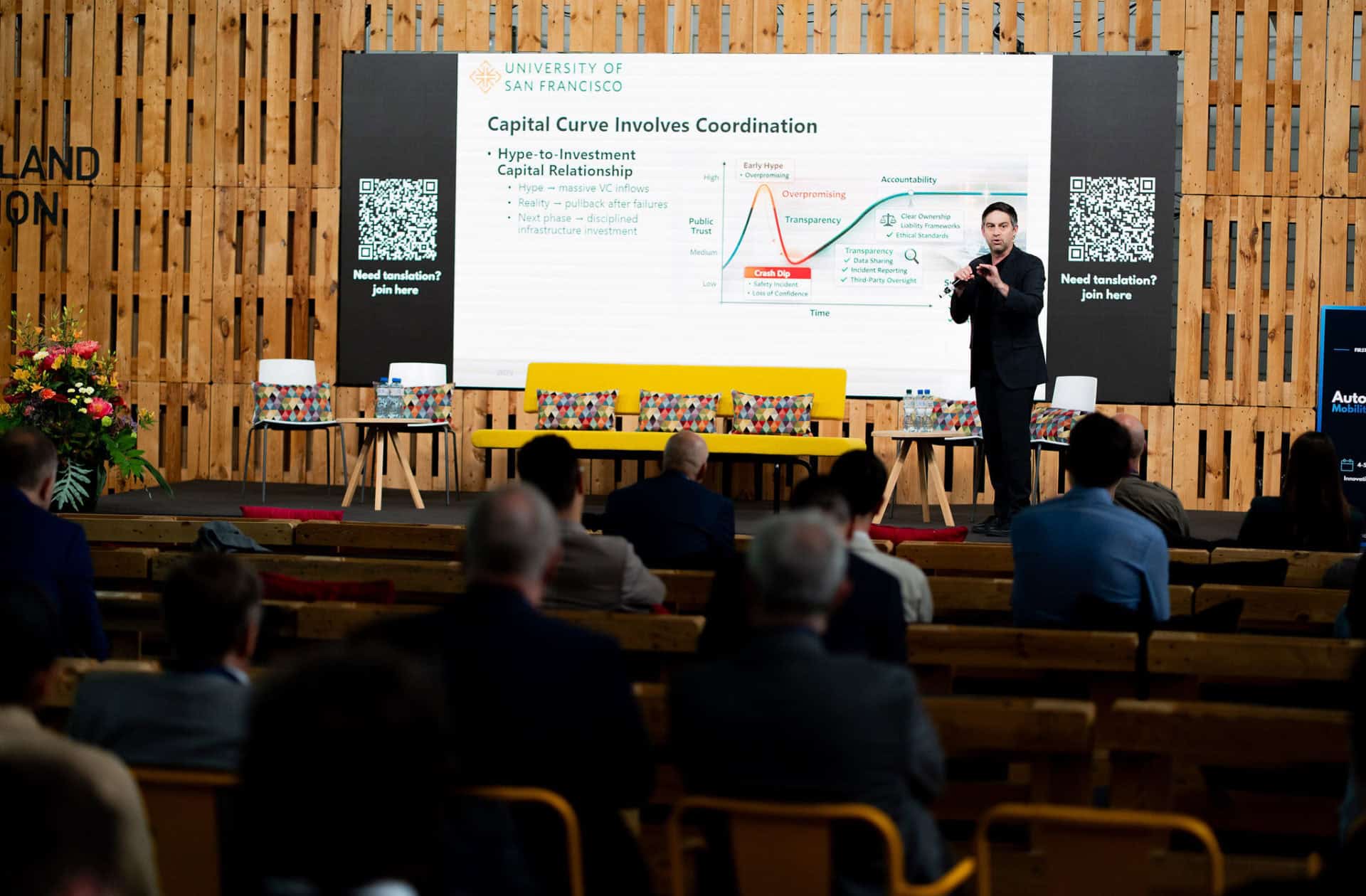
William Riggs (University of San Francisco) addressed venture capital and political economy aspects of the sector. His central argument: “This is not an innovation problem.” The technology exists and works. The challenge is financial and institutional. He mapped the capital stack layers in the industry (seed, growth, infrastructure, public) and identified the risk of value leakage out of Europe: the majority of players deploying on the continent are not headquartered in Europe, meaning that the value created by European deployments — IP, jobs, data, talent — is not anchored locally.
“Many of the companies that the EU wants to have here aren’t headquartered here. Unless there’s some kind of tied-up value retention here, there’s no anchor.”
— William Riggs, Professor, University of San Francisco
His recommendation to public investors: tie public funding to value retention criteria (jobs created locally, patents filed in the EU, data hosted within European borders). This vision found a direct echo in the remarks of Arwed Schmidt (EasyMile), who described the end of a decade of perpetually refinanced pilot projects that never achieved independence: “We can’t sustain pilots. The way forward can only be sustainable business.”
The final panel: is a self-sustaining business model possible in Europe?
Andreas Hermann (University of St Gallen) moderated the closing panel. Of the 80 pilot projects mapped across Europe, only 40 are still active. The question was posed: “Do we need another pilot project, or are we in a phase where we need to move to real-life applications, permanent services, self-funded?”
Koen Schietecatte (De Lijn, Belgium) offered the mosta structurally ambitious vision: AVs must become the backbone of on-demand networks, enabling a significant reduction in the total cost of ownership (TCO) of public services while shifting a growing share of costs onto direct users. He envisages a fundamental rebalancing: large buses on main corridors, and a massive fleet of on-demand autonomous vehicles for first and last miles, a genuine reform of the European public transport model.
Martin Lischka (HOLON) defended the full-service provider model (vehicle, software and financing integrated) claiming a 60% reduction in total cost of ownership through vertical integration. Christian Lichtmannecker (Mobileye) reframed the debate: the real question is not the ticket price, but the liberation of parking spaces, emission reductions and the transformation of car usage, positive externalities that justify a degree of public funding.
5. THE MAJOR DEBATES OF THE DAY
Three fault lines
Three structural tensions ran through all sessions:
Public integration vs. private competition
Public transport operators (De Lijn, Ruter) want to absorb AVs into their existing networks. Private platforms (Bolt, Uber) see B2G regulation as an opportunity but remain wedded to a competitive model. The risk, raised during Q&A, is cherry-picking: private operators concentrating on profitable zones and leaving loss-making territories entirely to public funding.
Integrated stack vs. decoupled AV / vehicle
Andreas Herzig (Deloitte) proposed treating the autonomous stack and the physical vehicle as two separately certifiable entities, in order to speed up homologation. Charlotte Eisner (Bolt) pushed back sharply: “The vehicle part cannot be seen as a dessert to this grand fiesta. It’s a vital ingredient from day one.” This technical debate conceals an economic one: if the stack is certified independently, value concentrates at the stack provider — Mobileye, Waymo Driver — at the expense of manufacturers and operators.
Europe as leader, or as deployment market?
Several speakers raised the concern that Europe risks becoming a market for technology developed elsewhere, without retaining the economic value. Others pointed to European capabilities (EasyMile, HOLON, Mobileye), regulatory strength as a barrier to entry, and Arwed Schmidt’s observation on design: “We are far away from having a dominant design. Neither when it comes to the interior, nor exterior, nor technology.”
Emerging consensus
Despite these divergences, several points of convergence emerged across the sessions:
- A move away from the pilot phase. Several speakers pointed to the need to move towards permanent, self-funded, at-scale deployments.
- Freight and ports before urban passengers. Nourie Boraie (Einride) predicted that Europe’s first major commercial wins will come from freight, particularly in port environments.
- Co-creation with users is non-negotiable for lasting adoption.
- B2G as the unexpected near-term catalyst for commercial take-off.
- A five-year horizon for Europe’s first large-scale commercial fleet — a timeframe referenced by several speakers, though the precise form remains uncertain.
Follow us on LinkedIn to stay
up-to-date with SAAM news!