
AMS 2027 takes place on 4 May 2027 at the Swiss Museum of Transport in Lucerne. In 2027, the acronym stands for Automated Mobility Switzerland: a national edition organised by SAAM, the Swiss Association for Autonomous Mobility, for the public authorities, operators, industry and research institutions involved in deploying automated vehicles in Switzerland.
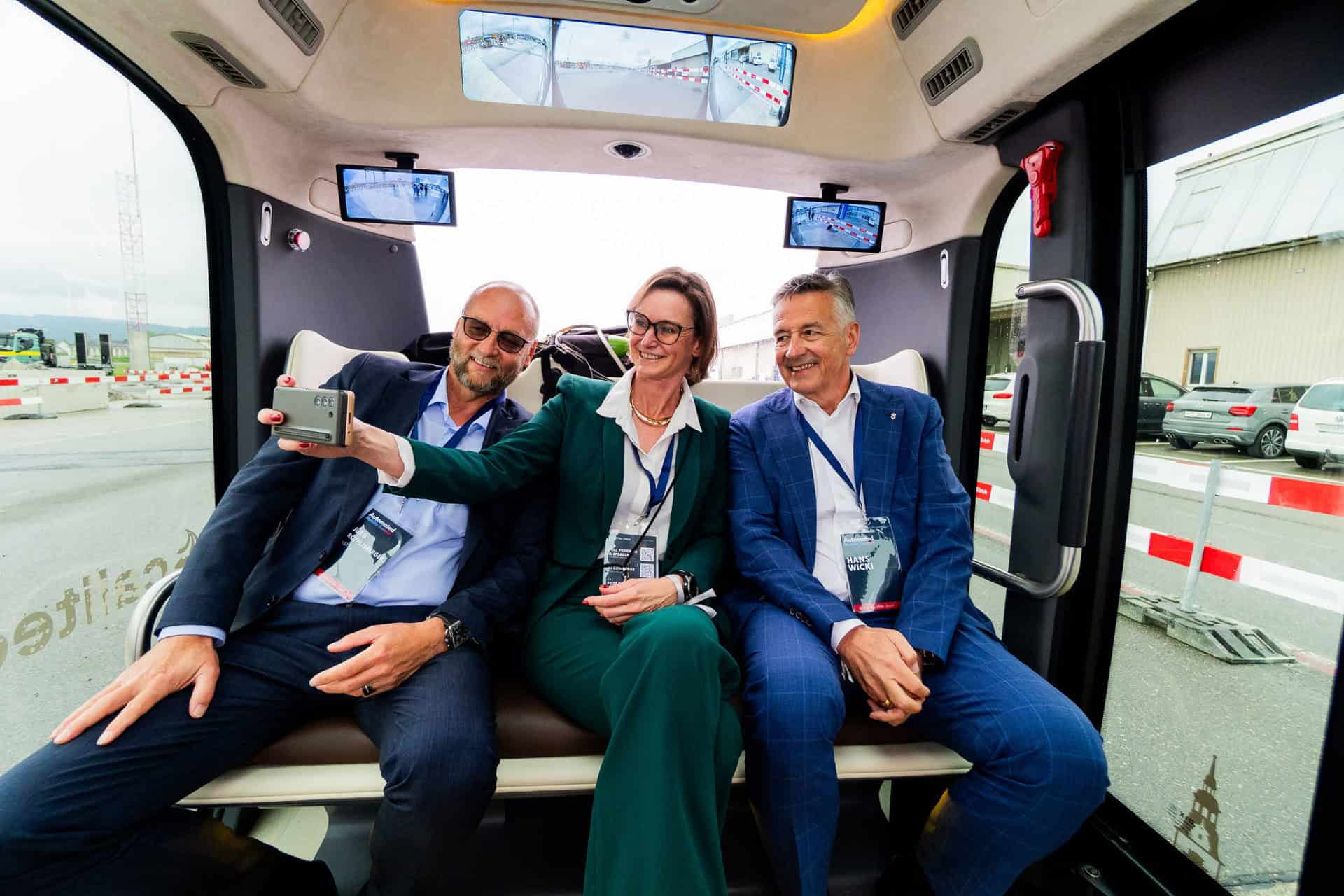
The 2026 edition, the Automated Mobility Summit, took place over two days at Innovation Park Zurich, with international speakers and a programme dedicated to developments abroad. AMS 2027 is shorter and focused on Switzerland. Ticketing for AMS 2027 opens on 12 January 2027. Visitors can register on automatedmobilitysummit.ch to be informed when it opens.
One name, two formats: AMS alternates between national and international editions
From 2027, AMS follows a fixed rhythm. In odd years, Automated Mobility Switzerland is the national edition. In even years, the Automated Mobility Summit is the international edition. The next international edition is planned for 2028.
The acronym and the visual identity stay the same. Participants, partners and media who know AMS find the same event, and the word after “Automated Mobility” indicates the scope of each edition. The fixed rhythm also gives partners a planning horizon for 2027 and 2028.
Why a national edition in 2027: the March 2028 deadline for cantons
The choice of a Swiss edition for AMS 2027 follows the timetable set by the federal Ordinance on Automated Driving (VAF), in force since 1 March 2025. The ordinance allows driverless vehicles on Swiss roads within approved operating areas, under the supervision of an operator.
The approval of these operating areas is a cantonal task. Under Art. 44 VAF, the canton responsible for registration examines and coordinates the application and grants the approval. The municipalities concerned must be consulted. If the area extends into another canton or onto a national road, the consent of that canton or of the Federal Roads Office (FEDRO/ASTRA) is required.
Art. 51 VAF provides a transition period: during the first three years after entry into force, there is no legal entitlement to have such an application assessed. As the ordinance entered into force on 1 March 2025, this period ends on 1 March 2028. From that date, cantons must be able to process applications. FEDRO’s guidelines on the approval of operating areas for driverless vehicles have applied since 1 January 2026.
Cantonal authorities are preparing for these new tasks. AMS 2027 takes place ten months before the end of the transition period. It is designed as a meeting point between the authorities that will assess applications and the operators, manufacturers and researchers who will submit or support them.
What the new tasks mean for cantons and cities
For a canton, an application for an operating area involves several questions set out in the ordinance. Art. 45 VAF lists the conditions: the vehicles must be able to perform the driving task on their own in the requested area, traffic must not be impeded, and operators and communication must be ensured. The approval must be granted if no local reasons stand in the way. FEDRO’s guidelines and assessment tool cover the effects of a requested area on road safety, traffic flow and the needs of pedestrians and cyclists.
For a city or a municipality, the role is different. Municipalities are not the approving authority, but they must be heard on every application that concerns their territory (Art. 44 para. 3 VAF). This hearing is where local questions, such as stops, street design or the link with local public transport, can be raised.
Some cantons have already adapted their own rules. The Canton of Bern, for example, will apply a partial revision of its traffic ordinance from 1 January 2027, under which its road traffic office reviews and coordinates applications for operating areas.
Who AMS 2027 is for
AMS 2027 is aimed at the people who will deal with driverless vehicle projects in Switzerland in the coming years:
- cantonal road traffic offices, civil engineering and mobility departments
- cities and municipalities that may host operating areas
- public transport companies and operators
- vehicle manufacturers, importers and technology providers
- research institutions and universities
- SAAM members and partners
The programme will be published on automatedmobilitysummit.ch as it is confirmed.
FAQ: driverless vehicles in Switzerland
Two levels are involved. The vehicle and its automation system need a type approval, which requires a whole-vehicle approval issued in an EU or EEA member state (Art. 11 and 12 VAF). The operating area, meaning where the vehicle may drive, is approved by the canton of registration (Art. 44 VAF). The municipalities concerned are heard, and FEDRO’s consent is needed for national roads.
The holder applies to the canton of registration, as for any vehicle. For a driverless vehicle, the vehicle registration document and the licence plates are only issued once the operating area has been approved (amended Art. 71 VZV, annex to the VAF). The registration document states whether and where manual controls are fitted (Art. 40 VAF). Driverless vehicles are inspected one year after first registration and then every year.
The cantonal road traffic office of the canton of registration, the same authority that registers conventional vehicles. Only holders with a registered office or residence in Switzerland can apply for an operating area (Art. 43 VAF).
An operating area is the defined route or zone in which a driverless vehicle may operate. The holder describes it in the application, and the canton assesses it on the basis of the conditions in Art. 45 VAF and the FEDRO guidelines in force since 1 January 2026.
No driver is needed, but a natural person, the operator, must supervise the vehicle while it is in operation (Art. 34 VAF). The operator can work inside or outside the vehicle, must be based in Switzerland, hold at least a category B driving licence and complete a training course provided by the manufacturer (Art. 36 and 37 VAF).
The holder must keep the automation system updated and maintained, carry out a check before daily operation, ensure that the vehicle only runs in the approved area under the supervision of an operator, and ensure that the police can contact the operator (Art. 38 VAF). A company must name a responsible natural person.
During the transition period, which ends on 1 March 2028, there is no legal entitlement to have an application assessed (Art. 51 VAF). From that date, cantons must be able to process applications for operating areas.
The ordinance allows a motorway pilot, with the driver ready to take back control when prompted, and automated parking in designated car parks. According to FEDRO, these systems can only be used once they are approved for Swiss roads.
Sources and further reading
- Ordinance on Automated Driving (VAF), FEDRO
- Ordinance on Automated Driving, FEDRO overview
- Driverless vehicles: FEDRO guidelines and assessment tool
- Canton of Bern rules for automated driving from 2027, plattformj.ch, 16 October 2026
For the Swiss legal framework, see our Guides & Regulations page and the SAAM Toolbox. The SAAM Roadmap 2026-2040 sets out the phases and fields of action for automated mobility in Switzerland.
Follow us on LinkedIn to stay up-to-date with SAAM news!