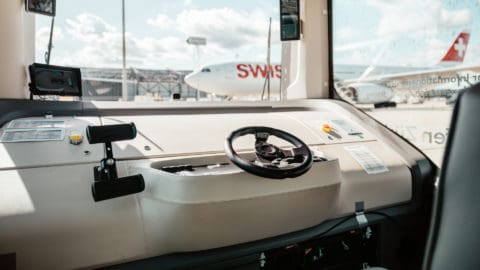


After two years of research, the Horizon Europe project CCAM-ERAS presented its final results in Brussels on 9 June 2026. The consortium studied how Connected, Cooperative and Automated Mobility (CCAM) will change transport employment in Europe: which jobs are likely to decline, which occupations are emerging, and which automated mobility skills workers and institutions will need. SAAM, the Swiss partner in the project, ran its training activities with Swiss public authorities. This article summarises the key findings and what they mean for Switzerland.
A two-year study of automated mobility and employment
CCAM-ERAS brings together 13 partners from nine countries. Panteia (Netherlands) coordinates the project, which the European Commission funds under Horizon Europe. The State Secretariat for Education, Research and Innovation (SERI) funds Swiss participation.
The researchers combined four strands of work: employment modelling, skills foresight, a socio-economic impact assessment and policy recommendations. They built their analysis on an inventory of tasks across six real-world use cases, from port and terminal logistics to shared and public transport.
Key findings: some jobs decline, others appear
According to the project, the clearest losses concern truck drivers, taxi drivers and manual maintenance roles, as automated systems take over more of the driving task.
The researchers also describe a wider reconfiguration of tasks. Drivers and technicians move into supervisory, diagnostic and digitally supported roles. New positions appear to plan, run, regulate and secure automated mobility systems.
The project concludes that Europe’s tight labour market will offset these losses to a large degree with new roles. The condition, in the researchers’ assessment, is that workers can be reskilled into those roles fast enough to keep pace with the technology.
Twelve emerging occupations in four areas
CCAM-ERAS identified twelve occupations and grouped them into four areas:
- Running CCAM day-to-day: customer service agents, fleet orchestrators, remote operations specialists, technicians, safety drivers
- Preparing the ground for deployment: infrastructure planning and engineering roles
- Policy and regulation: policy officers, insurance underwriters, app interface developers
- Building the underlying technology: AV systems engineers, compliance officers, cybersecurity specialists
The project publishes an occupational profile for each role, with the tasks and skills it involves.
Skills gaps are already visible
The consortium reports that skills gaps already exist and expects them to widen, because education and training systems adapt more slowly than the technology. The gap weighs most on workers leaving declining driving and maintenance roles. They will need clear pathways into the new occupations.
CCAM-ERAS recommends that employers, governments and education providers use the occupational profiles as the basis for training pathways now, ahead of demand. The partners tested these findings in a stakeholder workshop and by delivering initial training material to stakeholders who responded to them.
Public authorities are part of the transition
The skills question does not stop at operators and manufacturers. The authorities that approve and supervise automated services will also need new competences. Martin Clarke (Panteia) described this in an interview for the project:
“Authorities, regulators, inspectors, local authorities, need new skills to be able to support new projects and to ensure and supervise these systems safely. There’s also a need for continuous monitoring skills, because it’s a technological environment that keeps evolving.”
What CCAM-ERAS means for Switzerland
In Switzerland, this question comes with a date. The Ordinance on Automated Driving has been in force since 1 March 2025. From March 2028, the cantons will be responsible for authorising driverless vehicles on their territory. The CCAM-ERAS seminar report expects the first type-approved vehicles around 2027-2028.
What Swiss authorities reported
Within the project’s work package on training (WP5), SAAM organised a seminar in Bern on 25 June 2026. It brought together 23 representatives of cantonal, municipal and federal authorities from the German-, French- and Italian-speaking regions. The programme covered five modules: Swiss use cases and the technology behind them, the regulatory framework, operational safety, business models and public acceptance.
The seminar report documents the participants’ own assessment. Most of them said they were not yet ready to process a real authorisation request. The reasons they gave were consistent across language regions:
- no established authorisation process
- unclear legal bases at cantonal level
- unclear internal responsibilities
- limited in-house expertise
- no practical experience with real cases
The competences participants rated lowest all concern the authorisation task itself. They include assessing an operator’s safety measures and data protection, setting requirements on data, reporting and liability, and making or recommending a decision on a structured application. Participants also asked for models of inter-cantonal coordination, in particular for smaller cantons with limited capacity.
What SAAM will do next
SAAM will develop its offering for public authorities, cities and cantons.
The aim is that the people who will process authorisation requests have access to current and relevant information, and can carry out this task with the knowledge it requires. The topics requested by the seminar participants will guide this work: the authorisation process in detail, inter-cantonal coordination, and applied technical content.
Cantonal and municipal administrations that want to take part can contact SAAM at info@saam.swiss.
Where to find the results
The full CCAM-ERAS findings, including the employment modelling, skills foresight, socio-economic impact assessment and policy recommendations, are available on ccam-eras.org. The Swiss seminar report is published on the project website.
For the Swiss legal framework, see our Guides & Regulations page. The SAAM Roadmap 2026-2040 sets out the phases and fields of action for automated mobility in Switzerland.
CCAM-ERAS is funded by the European Union under Horizon Europe. Swiss participation is funded by the State Secretariat for Education, Research and Innovation (SERI). Views and opinions expressed are those of the author(s) only and do not necessarily reflect those of the European Union or the European Climate, Infrastructure and Environment Executive Agency (CINEA). Neither the European Union nor the granting authority can be held responsible for them.