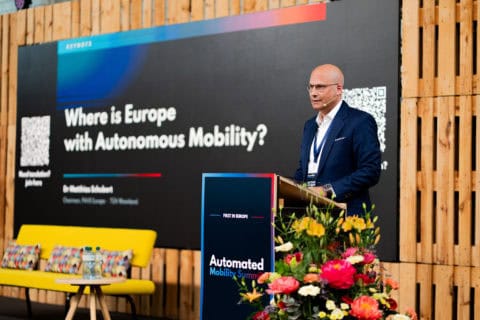

AUTOMATED MOBILITY SUMMIT KEY MESSAGES
- Switzerland has 33 autonomous vehicles operating on public roads since 2015, across 16 completed trials. Eight deployments are currently active.
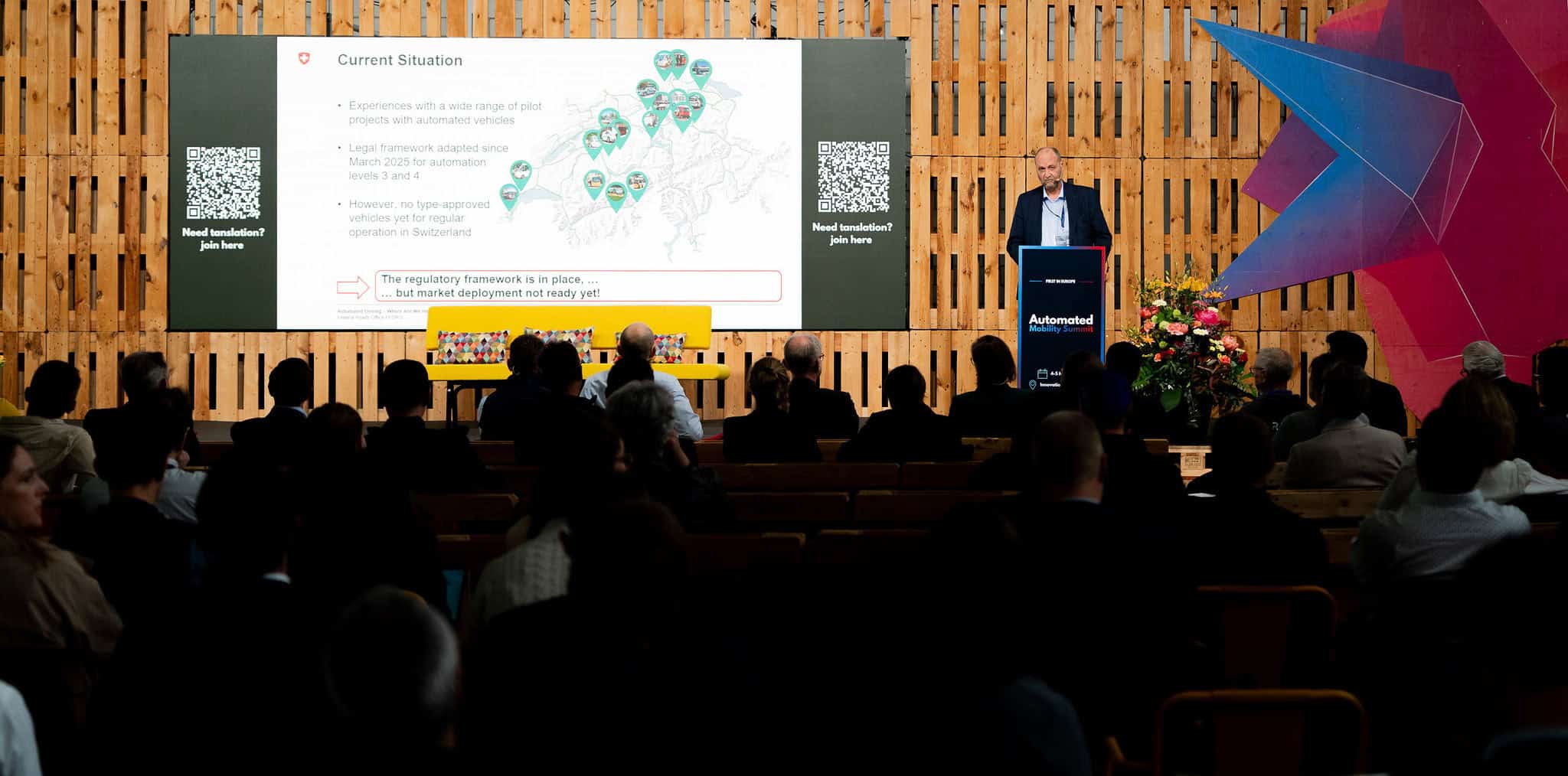
- The legal framework is in place. Since 1 March 2025, Level 3 highway pilot, Level 4 driverless operations on approved routes, and automated parking are all legally permitted in Switzerland. However, no vehicle has yet been type-approved for regular operation at L3 or L4. Type approval (homologation) was identified as the central bottleneck.
- The financing gap is the primary obstacle to scaling. The business case for autonomous public transport — based on significant driver cost reduction — was presented as viable. However, the transition phase requires public funding that current subsidy frameworks do not easily accommodate.
- Integration into public transport networks is the preferred model in Switzerland, rather than private AV ownership or ride-hailing. Panellists pointed to on-demand shared services extending existing public transport networks into underserved areas.
- The audience survey (approx. 300 participants) ranked regulation first, business models second and funding third among priorities for Swiss AV development. Technology was ranked last, suggesting participants consider the technology question substantially addressed.
- Cross-sector alignment — across cantons, cities, police, emergency services, operators, OEMs and regulators — was described as the defining organisational challenge for the next phase.
5 KEY THEMES OF DAY 2
- Switzerland as a living lab
- The regulatory momentum: legal framework in place, homologation still the bottleneck
- The way ahead – presentation of the Swiss Roadmap
- From pilots to permanence
- Who does what next: concrete actions, open questions and the 2040 vision
1. SWITZERLAND AS A LIVING LAB
Zurich as a location for AV development
Markus Müller (Standortförderung Zürich) opened by referencing a recent newspaper headline declaring Zurich the site of “the race to the robotaxi.” He described several factors attracting AV companies to Zurich: a complex layered traffic system, proximity to AI companies including OpenAI, Anthropic and the hyperscalers, and the presence of ETH Zurich and the University of Zurich. The Switzerland Innovation Park Zurich, located at the former airfield at Dübendorf, offers testing space to innovators.
Peter Bodmer, president of the Switzerland Innovation Park Foundation, described the park’s ambition: by 2050, a deep-tech hub generating 15,000 jobs on-site, with autonomous mobility as a flagship application. “Here we don’t just aim for incremental steps,” he said — “we strive for disruptive leaps.”
33 vehicles and counting: the Swiss deployment landscape
Oliver Nahon (SAAM Director of Operations) provided an overview of AV activity in Switzerland. Since 2015, 33 autonomous vehicles have operated on Swiss public roads across 16 completed trials. Four deployments are currently active, in Bern, Arbon, the Furttal region and Eastern Switzerland, and we expect a cumulative 100 AVs (altogether, including all projects since 2015) on Swiss roads by end 2028.
I don’t like to use the word ‘project’ anymore. I would rather use the word ‘deployment.’ This is what it’s about now in Switzerland.” – Oliver Nahon, SAAM Director of Operations
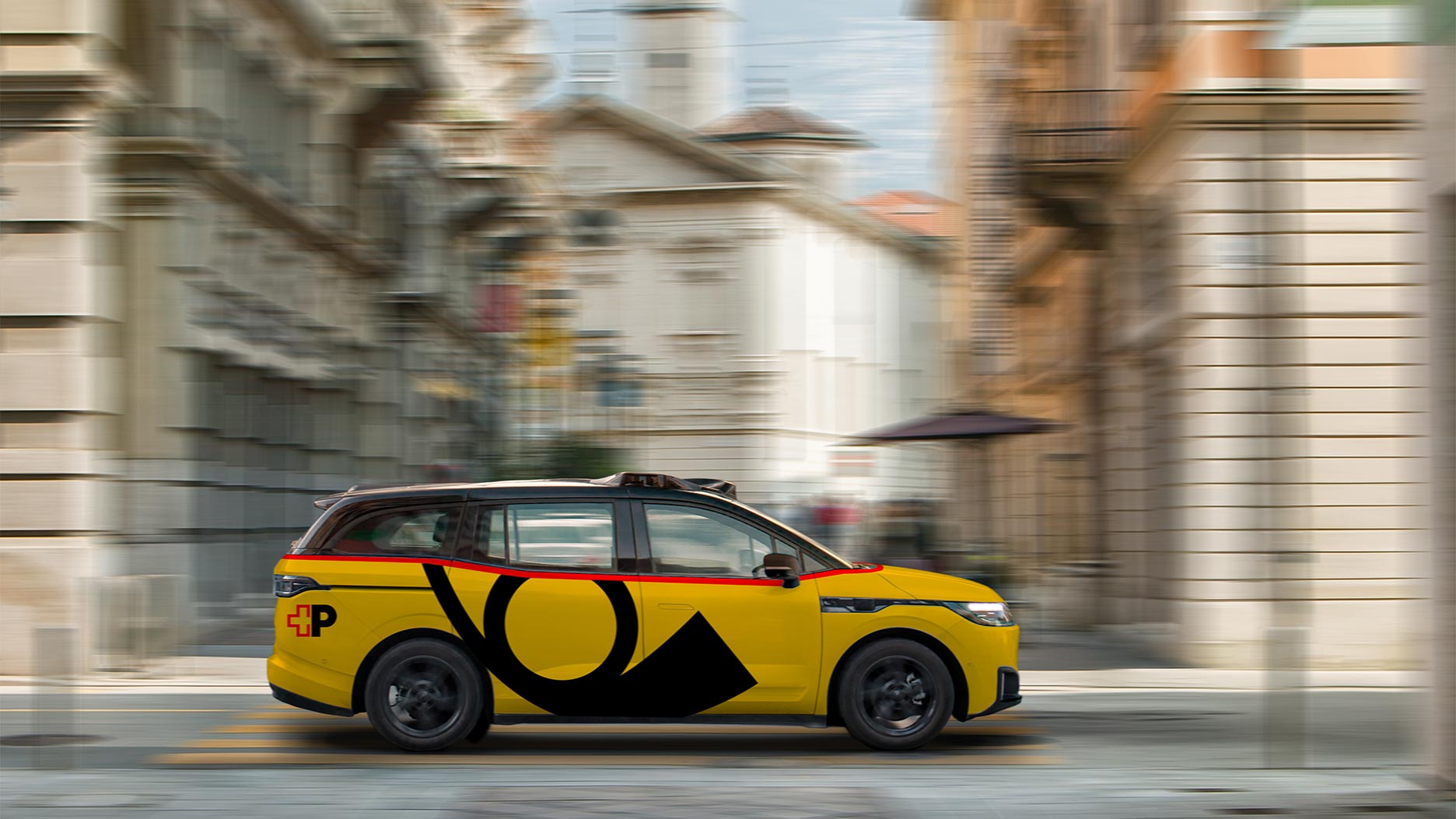
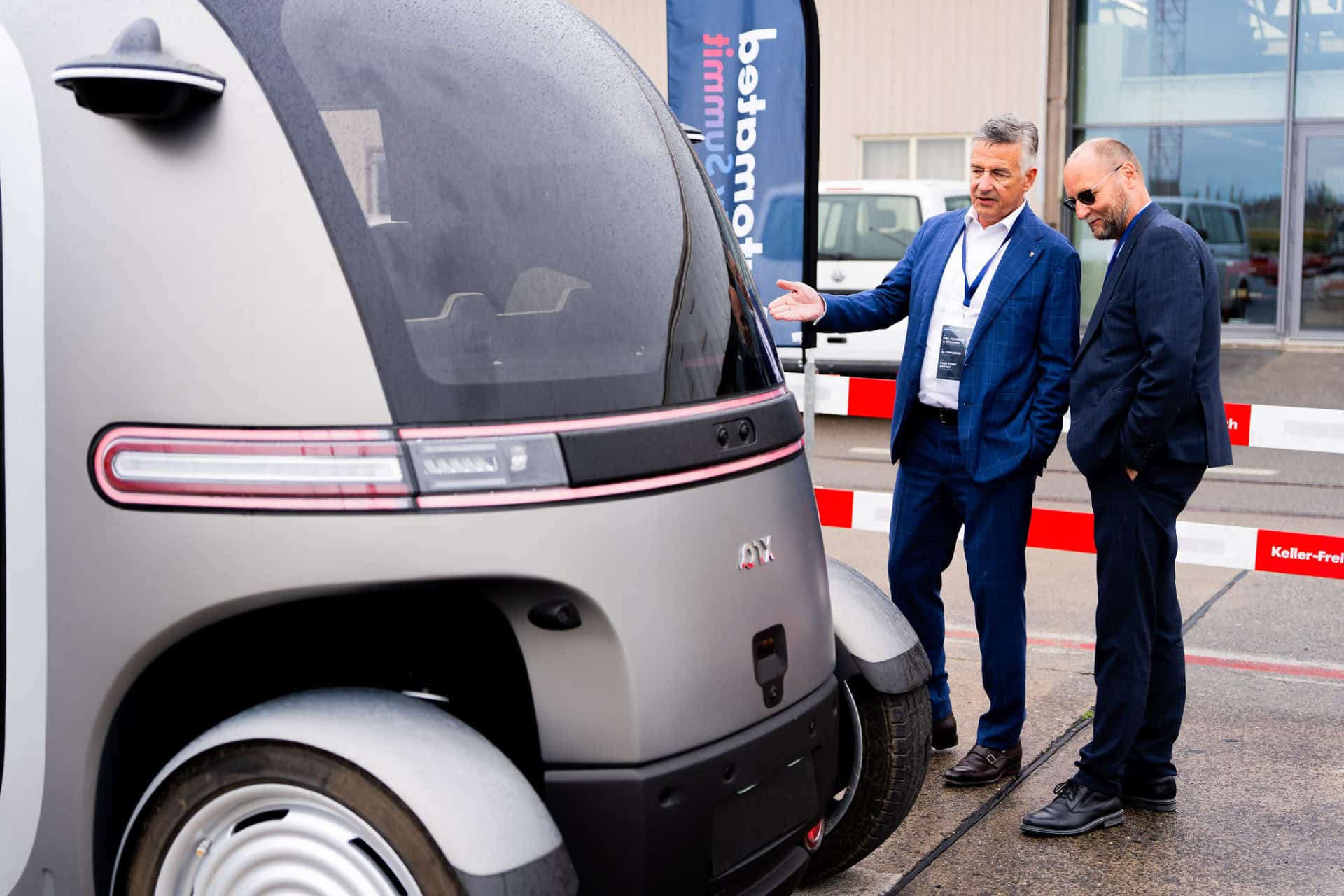
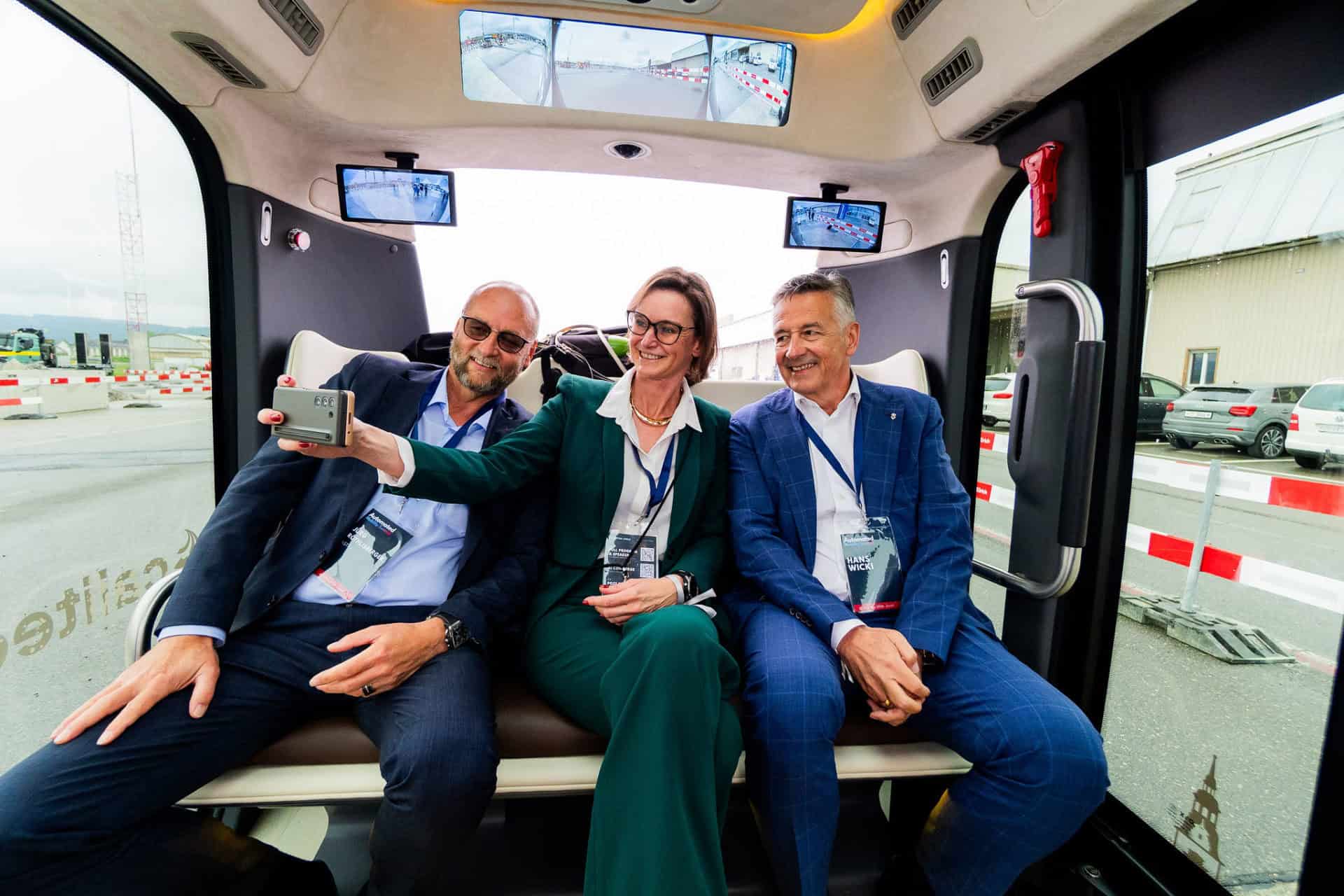
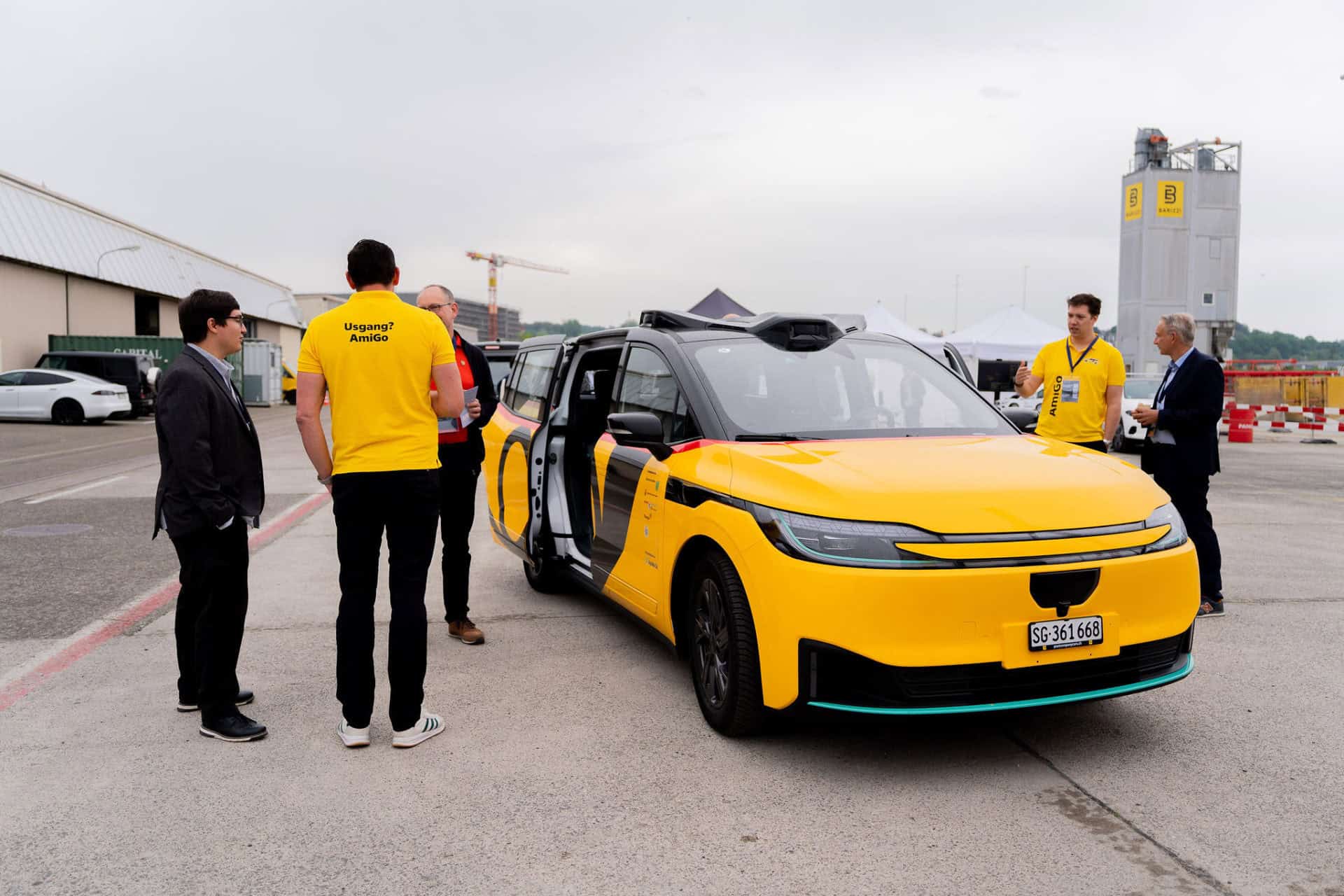
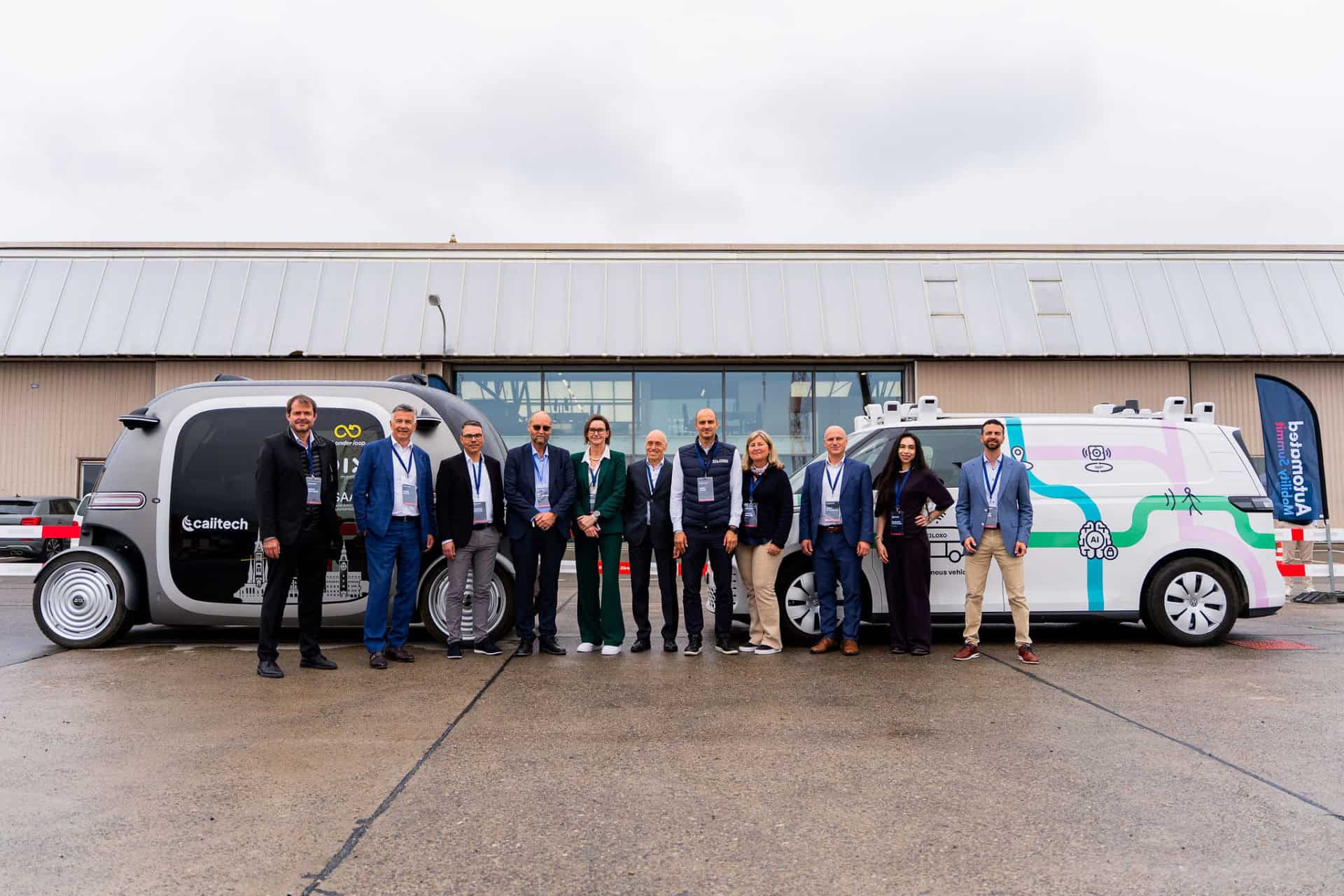
Eight autonomous vehicles were on display at Innovation Park Zurich throughout the event. Six were exhibited as static showcases, including vehicles from TGA, PostAuto/Apollo Go, AMAG, WeRide (Zurich Airport), WeRide and Deloitte, giving visitors the opportunity to explore the technology up close. Two vehicles, the LOXO logistics shuttle and the PIX RoboBus, were operating live on site, offering attendees the chance to experience a ride without a safety driver.
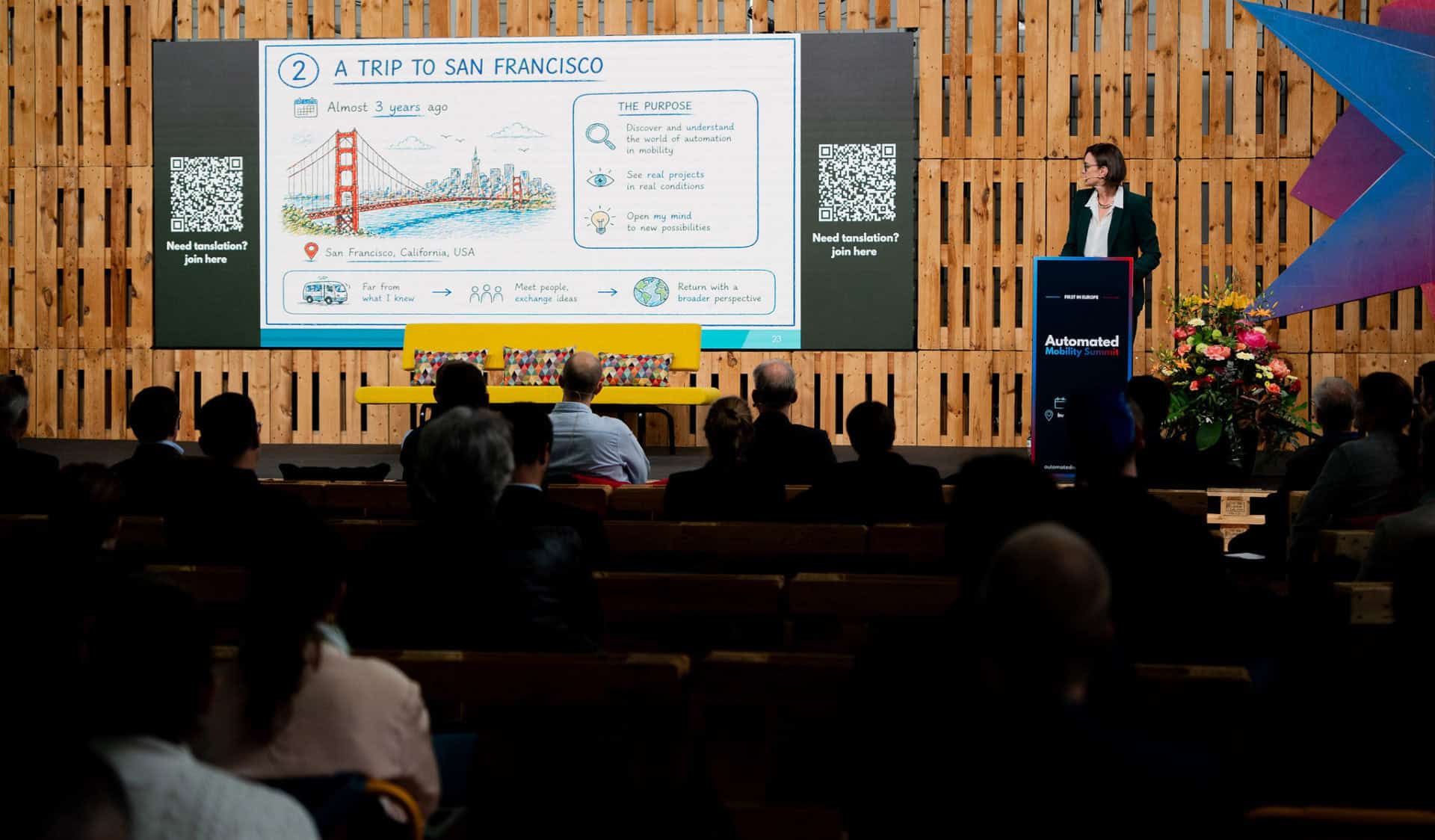
You will find a couple of illustrative pictures and videos below. Full picture gallery available here.
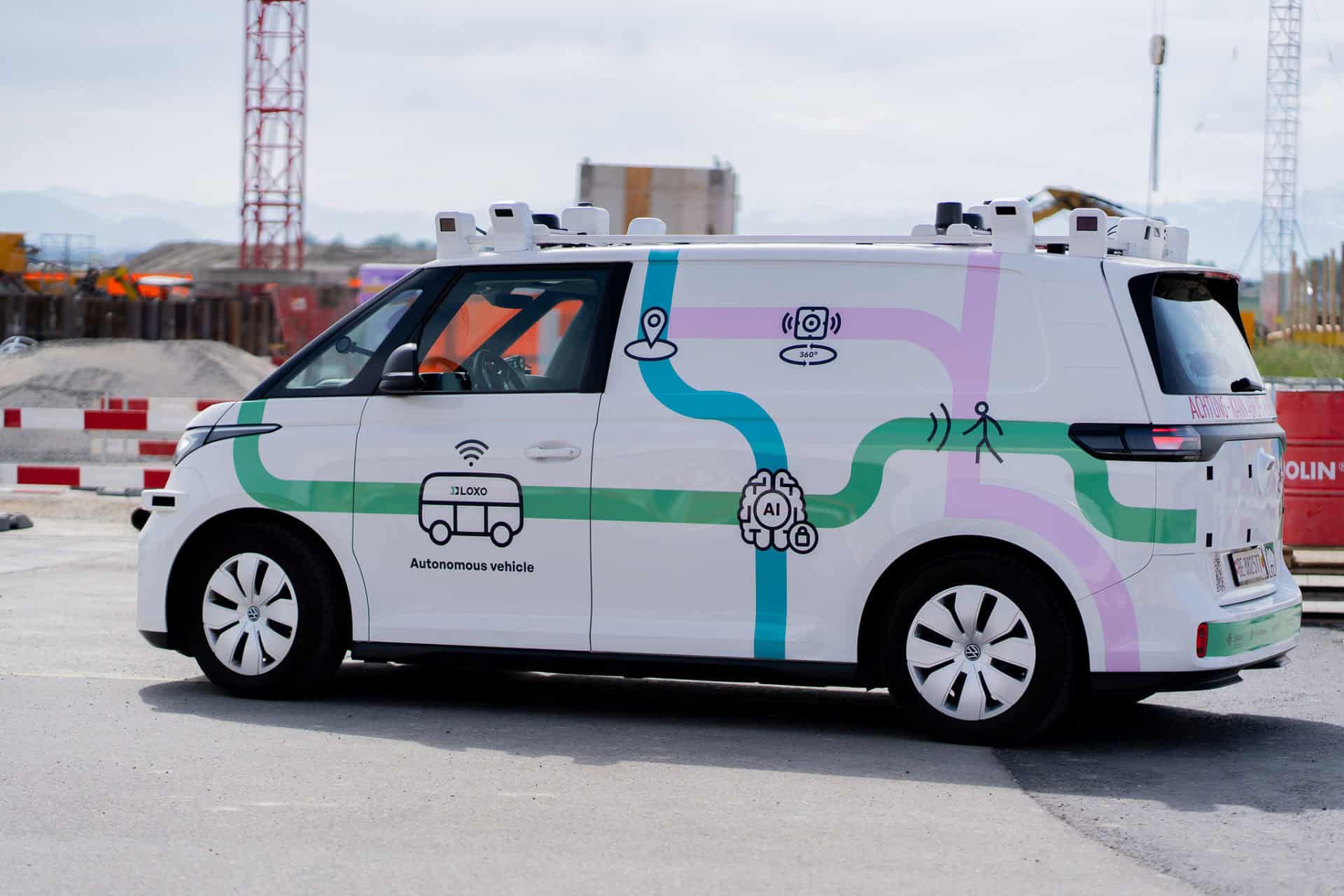
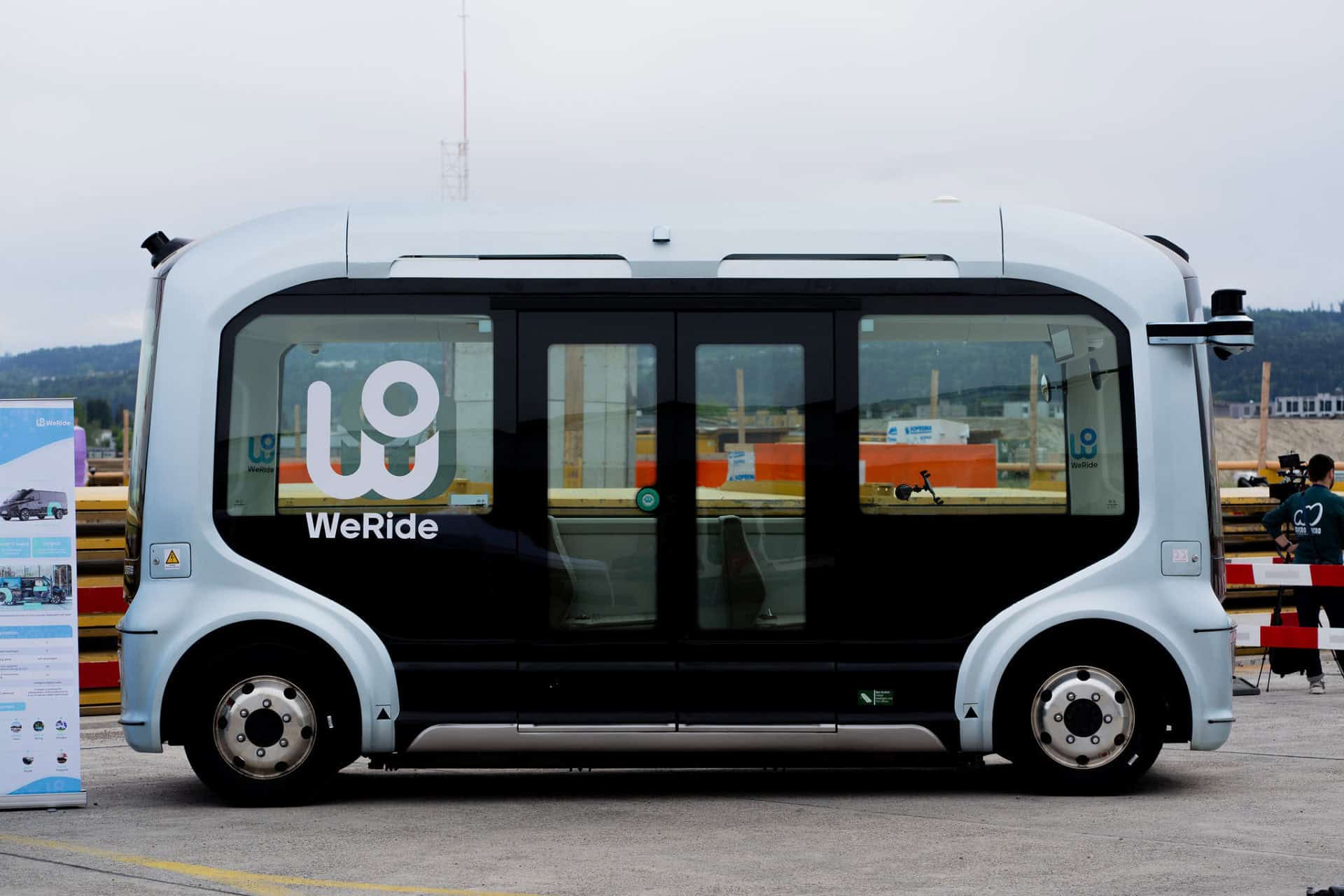
The deployements presentations that followed covered a range of use cases and sectors:
SWISS DEPLOYMENT SHOWCASE — HIGHLIGHTS
- LOXO/Planzer (Bjorn Linder): “Matilda”, autonomous last-mile parcel delivery on public streets in Bern since Sept. 2024, in partnership with Planzer. First dynamic micro-hub in Switzerland. No safety driver; received L4 certification in May 2026.
- Embotech (Fabien Kritter): L4 autonomous vehicle marshalling deployed at 5 BMW factories; 600,000 vehicles moved autonomously with 99%+ success rate. Autonomous tractor at Rotterdam port.
- ARTOUR (Hans-Ruedi Bruderer and team): Full-size autonomous bus on 9-stop route through the narrow streets of Arbon. 365 days/year, half-hourly service. 3,000+ passengers carried. Remote driving for the 5% of edge cases.
- PostAuto AMIGO (Martin Neubauer): 25 Apollo Go vehicles ordered for on-demand ride-pooling in Eastern Switzerland (~80 km²). Target: remove safety driver by 2027.
- ULTIMO : €50M EU-funded L4 on-demand project launching in the Geneva cross-border area (France / Switzerland) in mid-September 2025, 15 vehicles.
- Swiss Transit Lab (Matthias Rödter): Focused on building the business case and operational model for AV integration in public transport, ride-pooling, on-demand, fixed-line evaluation.
- Einride / ARRIVE: Cross-border AV project in the Basel tri-border region (CH / FR / DE). Blueprint for harmonised cross-border autonomous mobility in Europe.
- Zurich Airport (Raphaël Glaesener): Two autonomous shuttle buses (Nimbus & Stratus) on 6.5 km airfield route since April 2025. Received L4 certification in May 2026.
2. THE REGULATORY MOMENT: LEGAL FRAMEWORK IN PLACE, HOMOLOGATION STILL THE GAP
Switzerland’s three-track legal framework
Jürg Röthlisberger (Director, Federal Roads Office / FEDRO) delivered an authoritative regulatory update at the summit. Since 1 March 2025, three use cases are legally permitted in Switzerland:
- Level 3 highway pilot on approved motorway sections;
- Level 4 driverless vehicles on authority-approved routes;
- and automated parking in designated lots without a driver present.
The legal work is done. And yet :
“The regulations are in place, but the market is not yet ready. To this day, no vehicle has been approved for regular operation.” — Jürg Röthlisberger, Director, Federal Roads Office (FEDRO)
The immediate prize, in his view, is Level 3. With sufficient market penetration, studies show highway pilot systems could unlock up to 15% more capacity on existing Swiss motorways, reduce accidents and improve traffic flow, without any new infrastructure. He expressed clear frustration that manufacturers have yet to submit homologation applications, and signalled active discussions with OEMs, including possible incentive mechanisms such as reduced insurance premiums for drivers engaging the highway pilot system.
On Level 4, he acknowledged the structural risk: the industry appears eager to skip L3 entirely and deploy straight to fully driverless operations. While FEDRO has approved existing pilots via direct authorisation (“we took the risk”), the medium-term goal is for all L4 vehicles to achieve proper type approval through standard homologation. His target: within five years, all currently operating L4 vehicles should hold regular type approval.
Belgium’s parallel experience: a pragmatic, learning-by-doing model
Emmanuelle Vandamme (President, Committee “Federal Public Service Mobility and Transport”, Belgium) offered a counterpoint from Brussels. Her central message was about institutional humility: understanding AV technology is one thing; embedding it inside a multi-layered federal administration, with four governments, three linguistic regions and competing agendas, is a different challenge entirely. Belgium’s approach is built on a code of conduct rather than strict regulation, enabling rapid iteration while maintaining safety. “Test to believe, and learn to understand” is their operating principle.
Belgium is already running cross-border AV trials with France and coordinating Benelux-wide standardisation efforts. Vandamme named three pillars for any national AV strategy: trust (transparency, viability, keeping people central); governance (adaptive, coordinated public administration); and skills (investing in people, building the next generation of AV-literate public servants).
3. PRESENTATION OF THE SWISS ROADMAP 2026-20240
Rémy Chrétien presented the SAAM Roadmap 2026–2040, a reference document developed by SAAM over several years and made public for the first time at the AMS.
Starting from the observation that Switzerland already benefits from a high-quality, interconnected transport system worth preserving and building upon, the Roadmap sets out a vision, goals and a development scenario to 2040, covering passenger transport, freight and individual mobility.
The central vision is that automated vehicles should become an integral part of the mobility system, ensuring greater safety, efficiency and sustainability. Five goals structure this ambition:
- sustainability
- framework conditions
- acceptance
- accessibility
- integration into the mobility chain
The proposed scenario unfolds in three phases. The Foundation Phase (2026–2030) builds on existing pilot projects to validate business cases. The Establishment Phase (2030–2035) sees automated services roll out across several cities and municipalities. The Expansion Phase (2035–2040) marks the integration of automated vehicles as a standard component of the overall mobility fleet. Rémy Chrétien emphasised that this scenario is not a prediction but a starting point for discussion, one that may prove either too ambitious or not ambitious enough depending on how conditions evolve.
To turn the vision into reality, eight fields of action have been identified, spanning technology development, regulation, financing and social acceptance, among others. At the close of his presentation, Rémy Chrétien invited participants to indicate their two priorities among these eight fields via a survey, the results of which were presented and discussed during the panel session that followed.
4. FROM PILOTS TO PERMANENCE
The afternoon panel brought together Barbara Schaffner (National Councillor), Jürg Wittwer (TCS), Stefan Regli (PostAuto), Amin Amini (LOXO), Vibeke Harlem (Ruter AS, Norway) and Emmanuelle Vandamme (Belgium) to address three structured questions: Where should AV develop in Switzerland? What obstacles must be overcome? Who does what next? The answers were rich and sometimes sharply divergent.
“We are not here to pilot. We are here to stay.”
The most emotionally charged moment of the day came not from a technology demonstration but from a financing argument. Stefan Regli (CEO PostBus, Swiss Post) made the case with stark arithmetic: 40% of a PostAuto bus’s operating costs are personnel, the driver.
Project that cost forward to a fleet of 20 vehicles supervised by one remote operator, and the unit economics transform radically. “The business model will work. But it needs upfront investment — from the federal government, from the cantons — because public transport operators cannot self-finance this transition.” His word of choice throughout the session was unambiguous: “We are not doing a pilot. We are going to Eastern Switzerland to stay.”
“Forty percent of our costs are the driver. Once we can manage 20 vehicles with one remote operator, the economics change entirely. But someone has to fund the transition.”
— Stefan Regli, Head of Mobility Services / CEO PostBus, Swiss Post
Jürg Wittwer (CEO, TCS) provided the most provocative financial framing of the summit. Switzerland currently invests approximately CHF 8–12 billion per year in public transport subsidies. The percentage directed at autonomous mobility research and deployment is, he said, “impossible to measure, because it is effectively zero.” His proposal: a dedicated 1% levy on public transport subsidies, ring-fenced for AV deployment and research. At current subsidy levels, this would unlock CHF 80–120 million per year, enough, he argued, to transform Switzerland’s competitive position. “I think one of the tasks of the association is to do lobbying. I’m not sure we will succeed to get this 1%. But we can dream, and it would be good for Switzerland.”

The type approval unlock
Amin Amini (CEO & Co-Founder, LOXO) offered the most precise diagnosis of the bottleneck: type approval, or homologation. “This is the keyword that unlocks all our dreams,” he said. Every current L4 deployment in Switzerland operates under a bespoke authorisation, not a standardised type approval. Until there are commercially available, type-approved L4 vehicles on the Swiss and European market, the sector cannot achieve the scale, the repeatability or the investor confidence it needs. This point (raised by Jürg Röthlisberger, Amin Amini and Mathias Rödter) emerged as the single most concrete technical prerequisite for the next phase.
Vision: the bridge metaphor
The dominant framing that emerged, most articulately from Jürg Wittwer, was the “bridge” metaphor. Autonomous vehicles sit between traditional public transport and individually owned cars. Rather than replacing either, they can act as connective tissue: bridging the gap between fixed public transport lines and underserved areas; bridging the frequency gap between infrequent rural services and on-demand urban mobility; bridging the demographic gap for elderly, mobility-impaired or rural residents currently excluded from the transport system.
“Autonomous vehicles are kind of in between public transport and individual cars. They can build a bridge to optimise the whole system — and maybe one day the distinction between the two disappears anyway.”
— Jürg Wittwer, CEO, TCS
Barbara Schaffner (National Councillor) and Stefan Regli both expressed a consistent preference for AVs as part of the public transport system rather than privately owned additions to it. Barbara Schaffner was direct about the risk: “If you go the private ownership route, you’re going to run into a flood of additional traffic our roads cannot absorb.” Vibeke Harlem (Ruter) brought Oslo’s experience to bear: Ruter is now in its fifth and final pilot, planning a scale-up to 100–500 shared autonomous vehicles integrated into the public transport network. Their own modelling shows a fleet of 500 shared AVs in the Oslo region becoming financially self-sustaining within five years, primarily by drawing market share from private cars whose users will pay for the service.
Amin Amini introduced a critical counterpoint from the logistics perspective: in goods delivery, there are no subsidies and no transition funding. The business case must work from day one. This structural difference — public transport can be subsidised, logistics cannot — is why the freight and urban delivery sector may move faster and more decisively toward commercial AV deployment than passenger transport.
Key tensions that surfaced
Public transport integration vs. private AV ownership
Jürg Wittwer raised a scenario most panellists were reluctant to fully confront: electric vehicle prices will likely decrease over the next decade, adding L4 autonomy to a CHF 5,000–10,000 small vehicle becomes technically and economically feasible. If that happens, private autonomous ownership becomes a genuine prospect, and the question of whether AVs augment public transport or erode its ridership base becomes urgent. Barbara Schaffner acknowledged the risk of induced demand; Harlem noted that Norway’s electric vehicle boom has already increased total km driven by 5–15%, the opposite of what sustainability goals require.
Swiss federalism as enabler and obstacle
The Swiss confederation structure, which gives cantons and even communes authority over local road use, was acknowledged as both a source of deployment flexibility (cantons can move fast when willing) and a source of fragmentation. Barbara Schaffner noted that “even a small village has to define which roads can be used for a project.” Belgium faces the same challenge with its three autonomous regions, and Norway was held up as a contrast: a single national test law administered by one authority, making coordination significantly simpler. The implication was clear: Switzerland may need a more harmonised national framework as deployments move beyond pilots.
Is Switzerland moving fast enough?
Jürg Wittwer’s challenge was the sharpest of the day: “There was a time Switzerland led in solar energy. Today we are nowhere. There was a time we led in electric vehicles. We lost that too.” His concern is not the quality of current projects but the system’s capacity to sustain and accelerate them. Amin Amini offered a more optimistic reading: Switzerland has more AV deployments per capita than almost any European country, and the ecosystem: regulatory, industrial, academic, is genuinely world-class. His prescription: “Stop being humble. Be bold. Speak louder about what you achieve. Make more noise.”
5. OPEN QUESTIONS, CONSENSUS AND NEXT STEPS
What the room agreed on: the audience survey results
A real-time audience survey, administered by Stefan Schorb (HSG / University of St. Gallen) and analysed with AI-assisted synthesis, produced the day’s most telling data point. Asked to rank their top priorities from eight fields of action, the 300 participants gave the following ranking:
AUDIENCE SURVEY RESULTS — TOP PRIORITIES FOR SWISS AV DEVELOPMENT
- 1st Regulation — enabling and streamlining; governance and political steering; standards and type approval
- 2nd Business models — viable use cases, integration into existing services, cost reduction, virtual testing
- 3rd Funding — investor-ready business cases, public-private integration, responsibility and risk sharing
- Technology — ranked last: the room considered the technology question substantially solved
Amin Amini’s reaction was the most telling:
“A few years ago, technology was ranked first. I’m sure in three years, regulation won’t be on top either. What I expect to rise is operations. The industry is growing up.” — Amin Amini, CEO Loxo
Emmanuelle Vandamme noted the near-absence of trust in the results, not because it is unimportant, but because “we already trust the system in this room.” Both Jürg Röthlisberger and Jürg Wittwer observed that the three top priorities align precisely with the obstacles that delayed earlier Swiss technology leadership in solar and electric vehicles.
“When you just see it once, you kind of may react scared. But if you see it again and again and again, and then you have the option to sit into such a car – that builds trust, because you’re getting used to it.” — Barbara Schaffner (National Councillor)
Emerging consensus
- Type approval is the master unlock. Until commercially type-approved L4 vehicles exist, every deployment remains a bespoke authorisation — expensive, slow and not replicable at scale. This is the single most concrete prerequisite for the next phase.
- The pilot era is over. Every operator present, from PostAuto to LOXO to Swiss Transit Lab, explicitly rejected the framing of their work as “pilots.” The ambition is permanent, integrated, self-sustaining service.
- Integration into public transport is the preferred Swiss model — not private AV ownership, not ride-hailing, but on-demand shared services embedded in existing PT networks, extending their reach into underserved areas.
- Upfront public investment is unavoidable. The business case exists — PostAuto’s arithmetic on driver costs is compelling — but the transition phase requires public funding that current subsidy frameworks do not easily accommodate.
- Cross-sector alignment matters as much as technology. Amin Amini’s keyword “alignment” — across cities, cantons, police, emergency services, operators, OEMs and regulators — was endorsed broadly as the defining organisational challenge.
- Switzerland is performing better than it believes. The gap between Switzerland’s actual deployment record (among Europe’s strongest per capita) and its self-perception (cautious, slow, too humble) is an opportunity cost that should be actively addressed.
Open questions
- Who pays in the event of an accident? Liability at L4 remains an open regulatory question in Switzerland and Belgium. Insurance frameworks are being built, but the political assignment of responsibility is not yet settled.
- Public vs. private fleet ownership: does Switzerland build toward publicly operated shared AV fleets, or does it allow private AV ownership to emerge as vehicle costs fall? The answer will shape city design, modal share and public transport funding for decades.
- Can Swiss federalism be agile enough? Individual canton-level authorisations work for pilots but not for scalable national deployments. The question of whether harmonised national rules can be achieved without sacrificing local governance has not been resolved.
- Level 3 vs. Level 4: will manufacturers submit L3 highway pilot applications, or will the market skip directly to L4? FEDRO’s highway capacity and road safety case for L3 is strong, but the commercial logic for OEMs remains unclear.
- How to fund the transition phase? Jürg Wittwer’s “1% of public transport subsidies” proposal is provocative and specific, but it requires political will that no current national programme explicitly commits to.
The 2040 Vision
The panellists were asked to imagine a Swiss resident in 2040. The visions were strikingly convergent.
Emmanuelle Vandamme: just as her doctor once asked how she lived without a smartphone, her granddaughter will one day ask how she lived without autonomous vehicles, the technology will be invisible infrastructure.
Vibeke Harlem: her grandchildren will not need a driving licence.
Amin Amini: cities freed of bulky delivery traffic, replaced by lean, on-demand fleets that arrive when and where they are needed.
Stefan Regli: almost exclusively autonomous, primarily in the context of public transport. And
Jürg Wittwer:”Zero emission, zero deaths on the road, zero transfers, zero empty seats.”
Barbara Schaffner: she will still use her e-bike, the trains will be there, and the individual autonomous vehicle will be the option for weather, luggage, age or health, not the default but the safety net.
Closing words
Hans Wicki (Council of States, President of SAAM) closed the summit by coining what may become the sector’s working definition: “public individual transportation.” Neither purely collective nor purely private, this new category, on-demand, shared, integrated, accessible, is what Swiss autonomous mobility is reaching toward. The first edition of the AMS has given it a name. The next editions will measure how far it has travelled.
Follow us on LinkedIn to stay
up-to-date with SAAM news!